
Put Your Lights On
What keeps NYT Opinion writers up at night.

Hey now. All you children
Leave your lights on
Better leave your lights on
‘Cause there’s a monster living under your bed”~ Carlos Santana - Leave Your Lights On (Supernatural 1999)
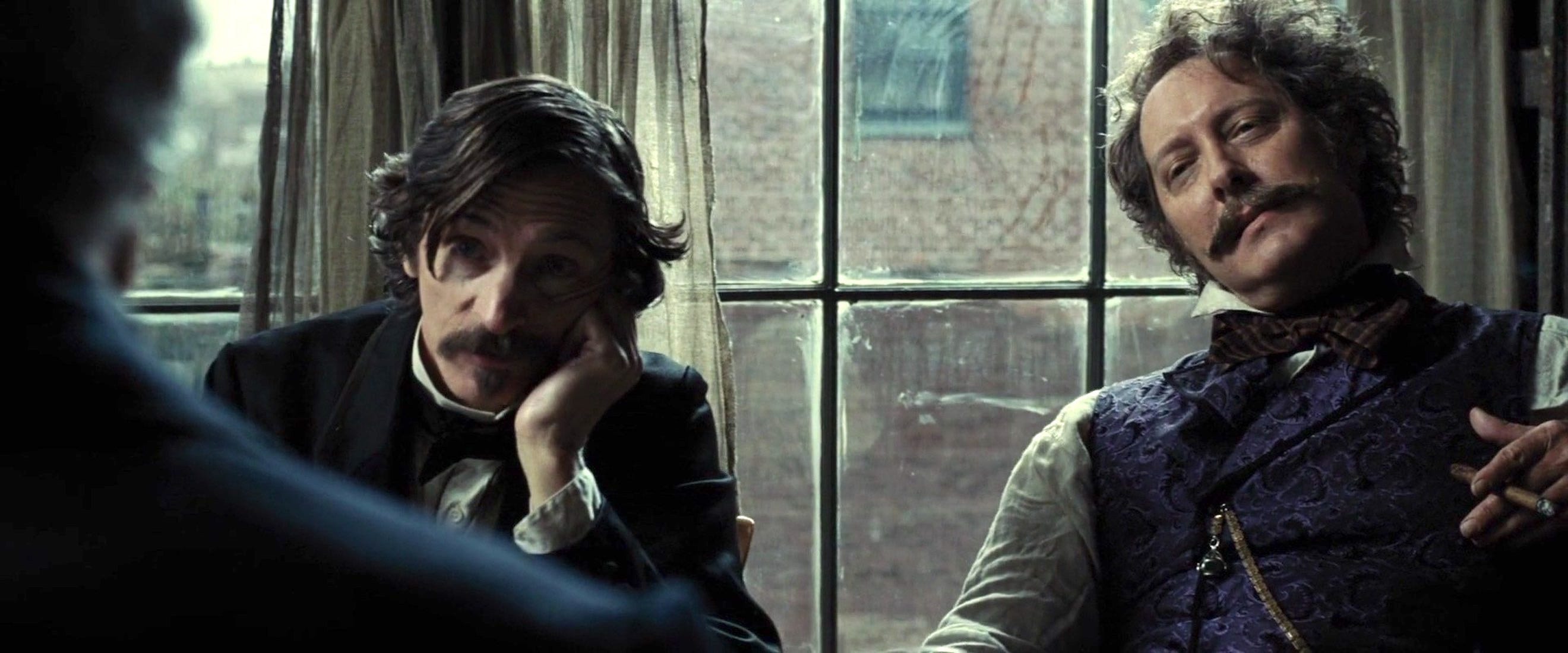
James Spader as W.N. Bilbo in Lincoln (2012) (Steven Spielberg)
In the past few days, a truly dear friend of mine who apparently reads the NYT, thus creating a niche subset in my ecosystem of which I had not previously been aware, sent me a link to an Opion piece penned by David French with the title “This Is What’s Keeping Me Up at Night”. Of course amongst the many things that must keep progressive senior journalists living in New York and working for the Old Gray Lady up at night, it will surprise no-one that the Evil Orange Man from 5th and now Pennsylvania Avenue, is foremost. He is the perennial monster under every progressive bed, at home and abroad, best combatted by shining the light of truth into every corner of the room. It must have been David French and his ilk that the sainted Carlos was thinking of when writing his iconic song from the 1999 album Supernatural.

I have linked to the article above but it is behind a paywall, so, on the not unrealistic assumption that subscribers to Pitchfork Papers are not also subscribers to the NYT, if you want to read it you may have to employ subterfuge and use archive.today to get the full text. To save you the trouble, the root cause of Mr. French’s insomnia appears to be the, in his eyes, high probability of the Trump administration pulling all the stops out to steal the midterm elections as a prelude to stealing the next Presidential election in 2028. A practice run, as it were.
This apparently very real and sleep depriving threat is based on the precedent of President Trump’s (obviously not very successful) attempt to steal the 2020 election and his incontrovertibly linked incitement of the crowd to instigate the Jan 6th insurrection, another embarrassing failure in the overall history of insurrections. Mr. French is particularly worried that the tactical employment of the Federal Contested Elections Act, which allows a candidate (for Congress) who feels that he (or she) should have been elected instead of the other fellow (or gal) to appeal to Congress to adjudicate the matter. He cites
Article I, Section 5 of the Constitution says that “Each house shall be the judge of the elections, returns and qualifications of its own members.” In plain English this means that the House and Senate make their own decisions regarding who belongs in each chamber of Congress, and those decisions are not reviewable by any other branch of government, including the courts.
Or, as the Supreme Court put it in a 1972 case called Roudebush v. Hartke, “Which candidate is entitled to be seated in the Senate is, to be sure, a nonjusticiable political question.”
The actual process for contesting an election to the House is governed by the Federal Contested Elections Act of 1969, a law that revised and updated previous legal procedures governing contested House elections. The law is detailed about process but largely silent about substance. The actual grounds for overturning an election are left to the discretion of the House (the Senate is governed by different rules).
The law gives a losing candidate, which it calls the “contestant,” 30 days after the certification of the election by state election officials to file a challenge with the House. The challenge is then referred to the Committee on House Administration, which investigates the contestant’s claims.
The contestant is supposed to bear the burden of proving that the election result should be reversed. But the matter is ultimately decided by a simple majority of the House, and the House can refuse to seat any member while the contestant’s challenge is pending.
The refusal to seat a member ought to happen only under exceptional circumstances, but those circumstances are up to the House, not the courts.
~ David French NYT 23.07.2026
Coupled with the appalling prospect that political candidates who feel that they have due cause for concern about the validity of the results in their electoral district might actually use established political procedural law to challenge that outcome, Mr. French notes that the personal integrity of the Speaker of the House - Mike Johnson - was such that he could not be counted on to uphold the law in favour of his own partisan preferences, contrasting him with Mike Pence in 2020, who could be and did. Apart from my confusion over the comparison with Pence’s role (he was VP and House Republican Conference Chair, a Congressional position a few notches below Johnson’s role today) and the fact that in 2020 Johnson’s role was held by that paragon of democratic and constitutional virtue, Nancy Pelosi, it seems, well, a little pot-calling-kettle-black-ish to impugn political actors on the other side of character flaws and guilt by projection and convict them in advance of a breach of trust sometime in the future. You know, just in case.
The same playbook is unfolding now, and I’m concerned, to put it mildly, that Mike Johnson is no Mike Pence. Johnson, in fact, filed a ludicrous brief at the Supreme Court in support of Trump’s challenges to the 2020 election outcomes in Georgia, Michigan, Pennsylvania and Wisconsin.
But far be it from me to criticise anyone’s right to invent whatever nightmares they wish to keep them from getting a good night’s kip.
Mr French goes on to cite several instances in US political history in which shenanigans of the sort disturbing his nightly peace had been in play.
We’re accustomed to voters having the final say, but America’s messy history indicates that this has not always been the case. In his paper, Jenkins found that there were 601 election contests in the House between 1789 and 2002, an average of around 5.6 per Congress.
Unsurprisingly, election contests increased in the late 19th century, as white Southern Democrats and Lincolnite Republicans battled for control in Congress, and dozens of those contests were successful. In many cases the contests were necessary, as white Southern Democrats tried to ruthlessly suppress Black representation in the postwar South.
In the spirit of fairness, he does cite cases in which in the past it was the Democrats - in those days an entirely different more conservative and reactionary party than today’s proto-socialist progressive platform - who were abusing due process to impede the “will of the people”, but he goes on to say that
If the Trump administration is good at anything, it’s good at resurrecting some of the worst ideas of the American past. Racist immigration policies, brutal federal violence, McCarthyite censorship of political opponents, destructive tariffs, fruitless foreign wars — the Trump administration is bringing it all back.
If one was being argumentative, which heaven forfend I would not dream of being, one might point out that, whilst that point may or may not be true, the Democrats are proving themselves exceedingly proficient at importing some of the worst ideas and policies from Europe of the present as well as having demonstrated admirably their own willingness to resort to “McCarthyite censorship of political opponents” along with “fruitless foreign wars”. As I have pointed out, pots and kettles and all that. Incontestable is the fact that we have definitely been here before:
Whilst I enjoyed reading the Opinion piece with a critical eye and am grateful to my friend for sharing the text and his own concerns, my sense is that it doesn’t matter much. It doesn’t matter which side of the aisle you are currently sitting, it doesn’t matter whether the filter on your perspective is tinted Blue or Red and it doesn’t matter who is doing what and to what degree exactly. What matters is understanding the current state of the Union in the context of the larger arc of the socio-political cycle. Only then can you begin to make some sense of what it means or is likely to. And adjust your sleep propensity accordingly.
So here is my take: I suspect that everything Mr. French writes about the Trump administration and the shenanigans his election apparatus is and will continue to engage in, is true or at least not substantively wrong. I also believe that whatever dirty games have been/ are being / will be played are not at all limited to the Republicans and that the Democratic Party is just as tarred by the same brush of corruption, rigging, self-serving, warping of the judiciary etc and that the appalling level of manipulation, grift and cheating on an previously unheard of scale (although that is probably not true) is much more of a sign of where we find ourselves in both the social cycle as it is of the cycle of Empire itself.
The stakes are enormous, the polarisation and the (low) calibre of the politicians themselves at an extreme (though possibly not as extreme as it may yet become) and the power of the elite class of monied interests controlling the the political process for their own oligarchical advantage rarely surpassed. I feel Paul Mellon might take issue with that last statement, but a little hyperbole can be stylistically forgiven.
And the stakes get higher with each “election” as each party has to fear increasingly aggressive reprisals from the party replacing it - not just impeachment but jail time, confiscation of assets and persecution of their family and tribe. If anyone thinks this is just about one side being thuggish whilst the other side is playing cricket, they are probably missing the larger context. Readers of the NYT, The Guardian in the UK and SZ in Germany see themselves as moral gatekeepers of “our democracy” and all the other Liberal Democratic virtues, demonizing “wrong-thinking” plebs who have the temerity to react against and reject the outcomes of increasingly socialist policies which ALWAYS end badly. Accusations of dirty elections and political gerrymandering are fine arenas in which to take a few high horses out of the stables and parade around. They have the added benefit of distracting the crowd from the more conceptually difficult areas of public administration in which graft, incompetence, mismanagement and ideological capture impose breathtakingly high costs on the society whose taxes are, after all, funding the circus.
Eventually - at the end of the cycle or the beginning of the next - public disgust with the entire ruling class leads to either / or civil war, military dictatorship or at least the election of military presidents (Washington, Grant and Eisenhower being prominent examples) with the promise to restore order. The US has a magnificent history of this and has always emerged stronger from the process. David French refers to the Depression era corruption - which interestingly aligns neatly with the final phase of the previous socio-political era, itself brought to an end by a World War and at whose conclusion a (Democratic) President who decided that the country couldn’t do without him, awarding himself an unprecedented third term in office. Just saying. The terms of Washington and Grant similarly came at the end of their relevant saeculorum and oversaw bloody civil conflict on which it fell to them and their administrations to impose order and new institutions. The old ones never go quietly.
Personally I have no idea if Trump is a super wizard fighting a meta battle we may not understand (geo-politically there is a good deal of evidence to support that perspective) or an out-of-control oligarch who played the game well and found a diabolically clever way of communicating a populist message whilst enriching himself and his family shamelessly or a dedicated swampdrainer looking to disembowel the Praetorian Guard nested in the Deep State (CIA/FED/Military-Industrial complex) or a mixture of all three. I have no idea and am neither clever nor well-informed enough to judge it properly. Time will tell, but we may need to wait a very long time before a critical appraisal and fair evaluation is possible.
What I do know is that we are in the middle of an historical inflection point at which most of the stuff we normies complain about is irrelevant. As Thomas More says to the Duke of Norfolk in A Man For All Seasons
“If [Cardinal] Wolsely falls, the splash will be enough to swamp a few small boats like ours”.
We are in for a splash at least as big as that, much as we may wish it otherwise - the debt burden and its unfinanceability will see to that all by itself. But that is for another post.
Meanwhile, I fear for what may emerge from the pens of Mr French and his colleagues over the coming months as they battle with the burden of sleep deprivation.
One detail regarding Pence. As VP, he was also "President of the Senate," and I believe it was in that capacity that he was seen as evidencing profound moral rectitude.
One could easily become despondent watching the parade of ignorant, corrupt, and odious midwits who have ensconced themselves in all levels of public and private bureaucracy. The projection is universal. Just as Trump Jr.'s crypto activities are at the very least unseemly, the widely acknowledged explosion in net worth of members of Congress (both parties) is prima facie evidence of profound corruption. (As they preen and mock third-world arrangements, ensnaring some inept business people in FCPA prosecutions while ignoring the Clinton Foundation's shenanigans.)
But there's hope. There's hope in the secular oscillations to which you allude (that Howe, Turchin, Friedman, Dalio, and others have documented). As unpleasant as it is, we are where we need to be as we purge the poison.
There is such profound ignorance in the US of the original intent of The Constitution.
Rights are not granted - by government, neighbors, etc.
They are ours inherently by virtue of birth. The individual, in the American system, is intended to be sovereign and unfettered by all but a few powers explicitly reserved to government. And there is to be an inverted pyramid - with the individual/family with sovereignty, then municipalities, then states, and finally the federal government.
That structure has been abused, serially, through bastardization of specific statutes like the Interstate Commerce Clause, and administrative law courts - unaccountable to anyone, much less the electorate from whom they inherit (illbegotten) authority. And most Americans know the story of rejecting a monarchy, yet are unaware of how we have embraced one that is far more insidious.
I maintain that the most profound single excerpt of our founding documents is found in Federalist 51: "It may be a reflection on human nature, that such devices [checks and balances] should be necessary to control the abuses of government. But what is government itself, but the greatest of all reflections on human nature? If men were angels, no government would be necessary. If angels were to govern men, neither external nor internal controls on government would be necessary. In framing a government which is to be administered by men over men, the great difficulty lies in this: you must first enable the government to control the governed; and in the next place oblige it to control itself. A dependence on the people is, no doubt, the primary control on the government; but experience has taught mankind the necessity of auxiliary precautions."
Men are not angels, as our laptop and government classes illustrate daily.
Awesome surmise of our political state and the state of those entrenching their lives and sleep in their beliefs