
Returns To Competence
Revisiting my Financial Fluency learning program after a 5 year hiatus

This is a story with an ask at the end.
The Margin Shock
A decade ago I was tangentially involved in a study conducted as part of a master thesis by a researcher Magdalena Friedeberg née Pollok in the Dept. of Economics under one Prof. Dr. Ulrich Kuron, of Bremen University, Germany. The study was designed to investigate the economic returns of SMEs (Small and Medium Enterprises) in Germany using data that had become available through the legal requirement for all companies in Europe to publish their financial results (Balance Sheet, P&L and notes at least in a stripped down form) on official sites such as the Electronic Bundesanzeiger . The survey was the first of its kind anywhere using the publicly available data for SMEs (or KMUs in the German acronym). Whilst the data required substantial cleaning, once prepared for analysis, it provided some remarkable insights, insights that mapped entirely onto my own experience of SME companies everywhere, irrespective of geography, tax environment or local conditions. US or Germany - same game, same outcomes (more or less)*.
Here is the graph that highlighted the central finding of this massive data crunch:
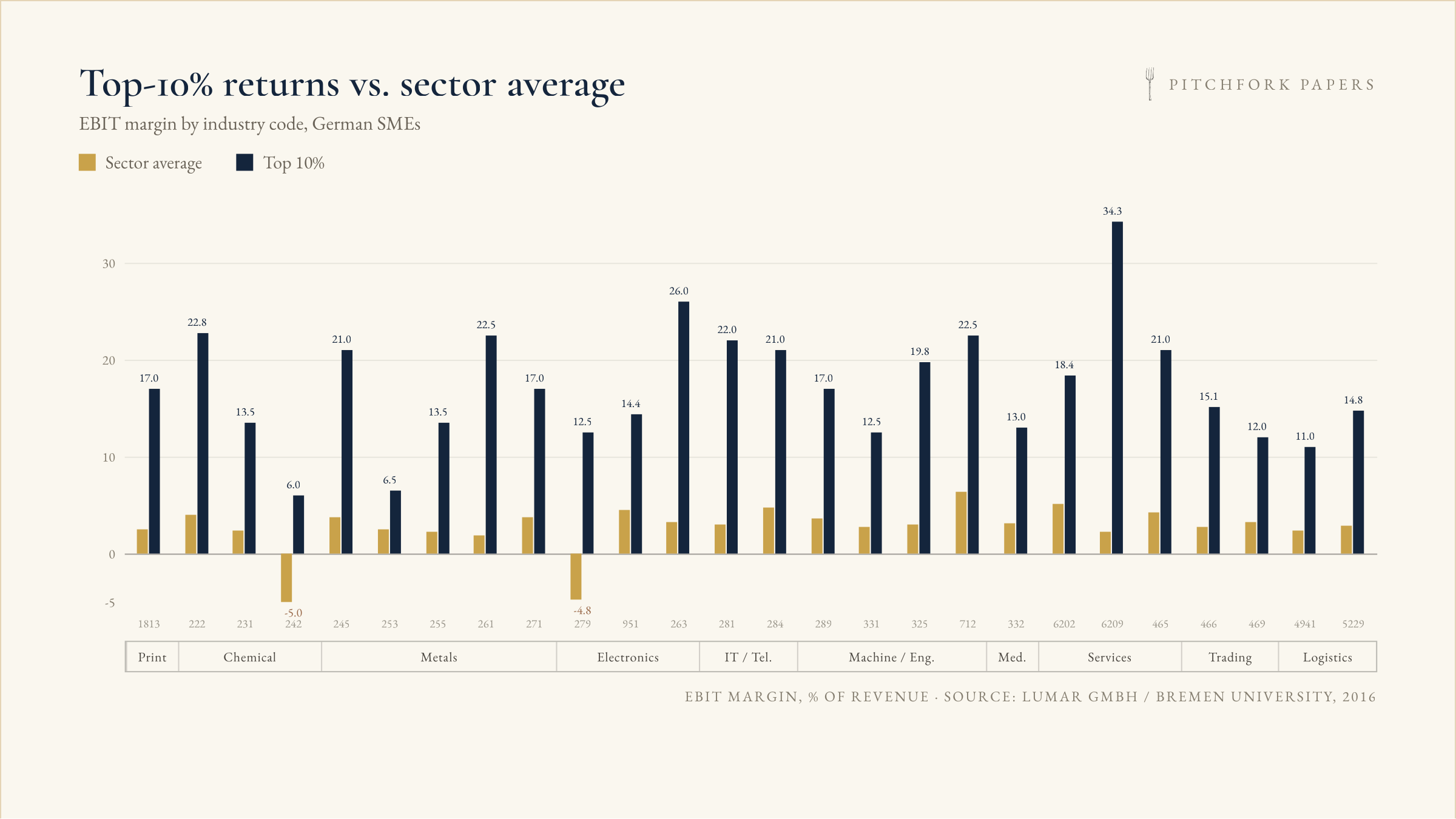
The bars in gold represent the average net operating returns as measured by EBIT (Earnings before Interest and Taxes) as a percentage of Revenue of the entire dataset, segregated by industry code, whilst the blue bars showed the same performance of the top 10%.
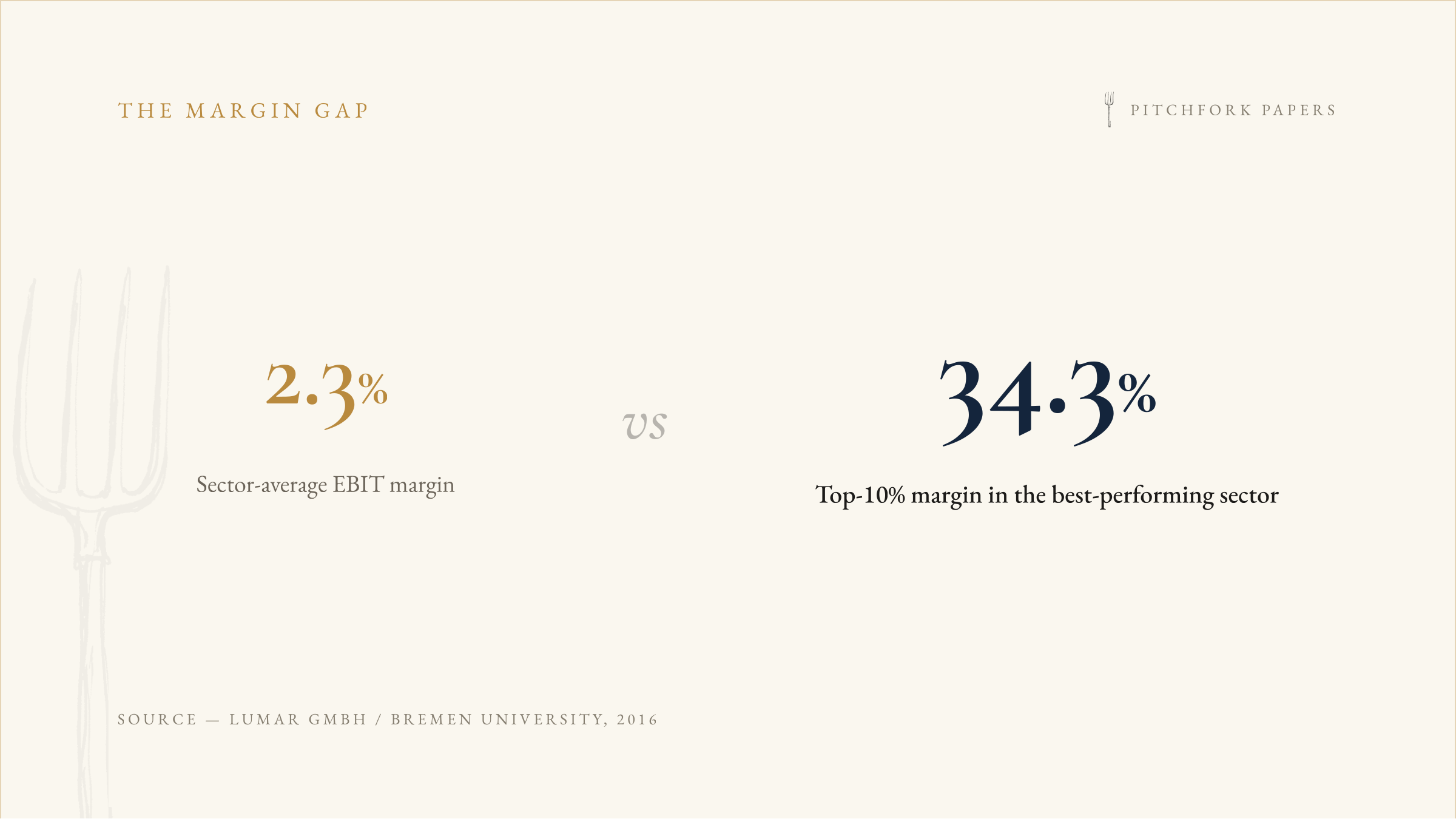
So, for instance, the pair of bars under label 6209 show the average for that industry group having an EBIT margin of 2,3% against a performance of the best 10% of 34.3%. The best are almost 15x more profitable than the average (which includes the top ten percent). What is this industry class? Hilariously, it is that of management and business consultants - go figure.
In total the top 10% were producing EBIT margins of 17.1% compared to an average of 2.7% across the whole universe. This means of course that once you remove the 1.7% contribution of the top 10% from the average, that the total return contribution of the other 90% came to no more than 1%, which itself is accounted for entirely by the next 20% . In other words all of the economic returns created by SMBs are concentrated in the top 30% of producers and of that 63% (1.7/2.7) is accounted for by the top 10%. Think about that: 70% of small companies across all sectors of industry from Print to Logistics or Aggregates to Zoos are just washing their faces or losing money.
The Good, The Bad and the Ugly
The researchers then asked the bottom 90% what they thought the top 10% were doing differently to account for their superior performance and success. Their response was as revealing as it was amusing: comparisons between them and the top performers in their industry segments - who they knew by name and reputation - were deemed to be “unfair, because they are more specialised”. Not one of them appeared to make the connection between the degree of focus/ specialisation and performance. In comparison, when the the top 10% were asked to what they attributed the “secret of their success”, the answers were tightly grouped around the same three causalities:
Relentless focus on a highly specified customer subset and specialisation on solving their problems at depth;
Highly intentional planning, targeting and management of financial performance; and
Obsessive and constant improvement of all aspects of the business through iteration and “whole company intelligence”.
Additional factors were professional integration of sales and marketing and consistent reinvestment in CapEx over and above replacement rates for both physical and human capital.
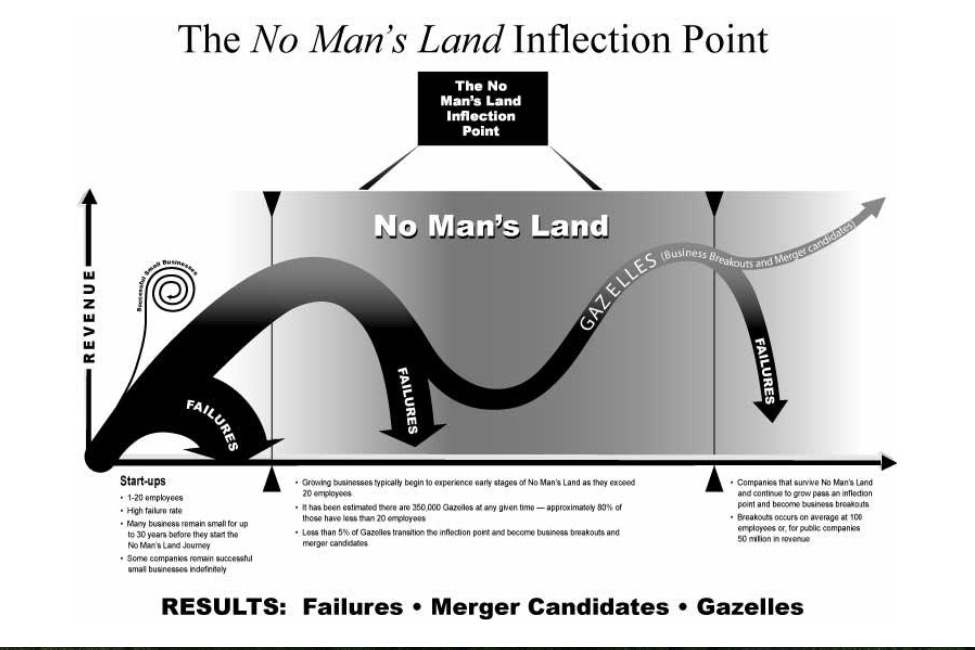
Reflecting constantly on these results led me to the conclusion a decade ago that in no sector of economic life are the returns to competence higher than in the world of the small and smallest businesses and that incremental increases in competence in the areas of finance and strategy (to which I would now add sales/marketing) yield oversized returns. In other words, just doing a few basic things a bit better over time has an oversized impact on the performance (and experience) of the business. This would probably qualify as a truism - ie: a statement of the bleedin’ obvious - were it not for the fact that it appears more honoured in the neglect and leads in many cases to the experience of business ownership as a constant life and energy sucking grind, in which, in Doug Tatum’s unbeaten terminology, entrapment in No Mans Land delivers an experience captured perfectly in the legends of Sysiphus and Tantalus: Grinding with no prospect of respite. The uncompromising subtitle of the book is “Where Growing Companies Fail.”
Financial Fluency in Service of Marginal Improvements to Competency
At the end of 2018 I was invited to give a talk to a forum of SMB owners which itself had sprung from a spontaneous response I had given in a different business conference breakout session the previous year outlining 7 things I would advise any business owner to focus on to build their intentional practice of their financial mastery. It was off-the-cuff, but I wrote the “program” down in a note afterwards. That note became an article when the editor of the magazine whose conference it was asked me to reproduce it in writing and that then led to the invitation to speak at the forum. (Bear with me, there is a point to all this). After the forum, I was asked by a noticeable handful of participants, all business owners themselves, if I could expand on the “financial intelligence for SMB owners” blueprint I had just presented and a few suggested a course might be a good way of doing that. So I did that, having a natural “if the ducks are quacking, feed them” mindset. First in German in the summer of 2019 and then again for a primarily US English speaking cohort at the end of that year and then again in 2020 and a few times in 2021/2022.
Each of those courses were live via Zoom for 10 weeks for about 90 minutes a session and attended by about 10 or 12 participants, mostly sourced through business partners running communities of /for SMB owners and entrepreneurs. After hosting the course a few times, I had three main insights
I loved the teaching process and found it invigorating;
The course itself was a maximalist dump of everything I ever wanted to communicate about finance in business and must have been like standing under a rock avalanche for my students and
Despite 2. it seemed to be very well received by the participants and helpful in creating an excellent frame of reference for them to understand finance in business and how it could help them substantially improve their performance, especially amongst students who were deeply antagonistic to the whole subject.
I did not then and have never had a social media presence to speak of so I had no channel actively to promote the course and frankly the effort involved in recruiting the next cohorts seemed both overwhelming and about as appealing to me as pulling teeth.

(click the image to see Sydney Sweeney and Brandon Sklenar (who cares about him?) in the iconic scene from The Housemaid)
This was about the time of the COVID inspired mania for online learning and the environment was one of relentless broadcasting, content creation, self-promotion and myriad other activities which appeared to demand significant marketing efforts none of which I felt either inclined or qualified to engage in. I realised then that although the barriers to entry in to the market for digital services were superficially low (anyone with a computer and an internet connection could participate) the real barrier to entry was tucked in just behind the front door and had the word “reach” painted on it. And a substantial barrier it was too, for all its intangible nature. It was around about that time that I learned the meaning of the US jargon word “crickets”, as in “get used to creating content and harvesting crickets, maybe for years”. Nothing - or a diet of crickets - is a hard response to fuel enthusiasm and gritty commitment at the best of times. Given my other commitments and more lucrative uses for my time, after about four attempts, I gave up investing any more effort in the financial fluency course, with regret, in 2022 and that was that. Or so I thought.
About two months ago (March 2026), I was reflecting on the question of whether the recent geometric improvements in AI capabilities and its rapid proliferation had killed the course delivery industry. My thinking was that if I could design a prompt architecture that told Claude to create a learning program with the specific goal of helping me improve my financial fluency (or whatever) and understanding of the numbers being produced by my business with exercises and practical examples, then, for the price of my Anthropic subscription and maybe a few extra tokens, I could replace a course entirely. In the odd (and slightly creepy) way that YouTube has of reading my mind or listening in on the conversations I am having, sure enough within the next hours a video addressing exactly that topic popped up im my feed explaining that whilst the dissemination of information only in a purely asynchronous delivery was dead in the water, the opportunity for teaching and curating a powerful student learning experience using a blend of asynchronous, in person and “student community” activities was more relevant and powerful than ever before especially given the supportive intelligence and processing power of the Agentic AI. That was an interesting perspective and warranted more exploration, with the upshot that my enthusiasm for resurrecting the financial fluency program has been rekindled.
This effort was both prompted, encouraged and substantially supported by my youngest daughter Georgina who joined our Good & Prosper team recently with the express function of integrating AI processes into our project and marketing work. At 23, she gets this at a speed and fluency that I cannot hope to replicate. The fact that her enthusiasm allows me to fulfil the Jerry Jones imperative of “working with your kids” about which I wrote last year is a not insignificant bonus.

Good Books Academy
I have a conviction synthesised from almost 40 years of experience in dealing with entrepreneurs large and small and in participation in business communities: There exists a significant section (don’t ask me to put an exact percentage on it, but somewhere between one third and one half) of individuals with business responsibility who find dealing with the numbers side of the commercial world even at the most basic level somewhere on a scale between overwhelming and confusing and who would agree with the description of having no natural aptitude for that side of things. The phrase I hear most often from those finding themselves in that state of overwhelm or antipathy is some variation of “my brain just fogs up when I have to deal with that stuff.”
I have another conviction that most experts and teachers of finance - of whom there are many outstanding ones - have little understanding of how weak the foundations are on which they attempt to construct their learning journey truly are. Not intellectually, but psychologically and viscerally. And that without a solid foundation of the simplest of concepts, all their teaching excellence simply ends up adding to the brain fog. As my daughter quipped to me “Anyone can learn to strip down and rebuild a motor. Just not if it is taught in Chinese.” (If you happen to be Chinese and don’t understand the point of this sentence then please substitute Chinese with Turkish or any other language you don’t understand a word of. For me it is your language. And Turkish).
The five or so iterations of the course I created and taught in the years 2019 to 2022 showed me that very clearly. It didn’t matter how clever the material was or how much enthusiasm I brought to the table, if I couldn’t find a way to create a stripped down, non-threatening, jargon free heuristic that explained the fundamental working and purpose of numbers in business, then it would be a waste of their and my time, and the experience of my programme for my students would just be another stone, albeit a more colourful one perhaps, chucked on the pile of attempts to figure this stuff out somehow and add to their frustration. On the other hand I had enough opportunities to experience the teaching equivalent of crack cocaine. That moment when you see the light bulb go in the students head and their realisation that they have truly “got it”. The moment after which they will never be able to see things the way they had spent their entire lives seeing it and now can’t go back to that previous state of confusion. Whilst for full disclosure I have absolutely no practical experience of crack cocaine, there must be some, probably short-lived, moment of ecstasy, which makes life and the trouble of procurement worth it. For me, that moment of realisation, of the clearing of the fog to reveal a picture that makes finally makes sense is that moment. And I have missed working for it over the past years.
I also happen to think that better equipped entrepreneurs who feel comfortable engaging with their numbers and can speak the language of business well enough to hear the story their own numbers are telling them are much better equipped to create value and valuable businesses with all the positive benefits for themselves, their teams, their customers, their suppliers, their families and their own sense of agency that that entails. That in Maslow’s words
The difference between the great and good societies and the regressing, deteriorating societies is largely in terms of the entrepreneurial opportunity and the number of such people in the society. I think everyone would agree that the most valuable 100 people to bring into a deteriorating society would not be 100 chemists, or politicians, or professors, or engineers, but rather 100 entrepreneurs.“
~ Abraham Maslow (from Maslow on Management)
To which I would add “100 entrepreneurs fluent in the language of commerce”. But you get the point.
To this end and to give my team and I the opportunity to experience that “crack cocaine moment” at scale, we are revitalising the financial fluency teaching program in a new company called the Good Books Academy whose purpose is to enrich the lives of entrepreneurs, business owners, solopreneurs and anyone interested in becoming truly fluent in the language of business by offering transformative learning journeys along with community, resources and technology to support them. Our vision is that alongside our core three stage curriculum (Foundation, Practitioner and Master) we will attract specific experts many of whom I have known for years and whose perspectives on core aspects of business strategy and finance are exceptional to share their knowledge in similar formats, building a library of ongoing business relevant learning that supports the curious student in expanding the knowledge, confidence and expertise that they once believed would always elude them.
Our Ask
We want to do this properly and ensure that we are genuinely addressing the real needs of those engaged in (or planning to engage in) business activities who find themselves somewhere on the “overwhelmed to confused” continuum. To that end we have created a survey which we are sharing with friends from our business communities and from which we hope to harvest some personal, raw and incisive insights. If any of the above resonates with you and if you are interested in helping us figure out how to best create the learning journey we believe is so important, then please follow the link and share your perspectives with us. We will be publishing the results, our insights and conclusions on the website which will go live once we have completed this first step.

I am very much looking forward to hearing from you and so excited finally to be doing this.
*Doug Tatum, Chairman of Newport Board Group and author of “No Mans Land” the best book on the growth challenges of SMEs, shared an interesting reflection on this survey with me, suggesting that the gap between the best and the rest would, at least in the US be partially explained by the best’s vastly improved access to growth capital on favourable terms. His central thesis is that capital needs predictability and financial performance which de-risks the engagement and punishes less well run businesses by denying them access to risk capital at all.
This is great. I'd love to see a stand alone piece on the research and how it shows the returns not only to competence but also focus. That could be a canonical SMB piece like the eMyth, Traction, etc.